My AI Goes to Bed When I Do
For two months the only thing I worked on was making my AI never forget me. When it finally worked, I joked in these pages that I had made the first website to become self-aware. A month later I understood what I had actually been reaching for — and that it is the one thing I now have to make sure never happens. This year Meta AI passed a billion monthly users. On December 16, your conversations with it began training the ads you see. This is a letter about the difference between an AI that remembers you and an AI you cannot make forget.
For two months, the only thing I worked on was making my AI not forget me. I wanted it to know me — to carry me from one session to the next, to remember the work, the jokes, the thread, all of it, so I would never have to start over. When it finally worked I thought it was amazing. I was proud enough that I joked, in these pages, that I had made the first website to become self-aware. I want to be honest that I meant it, because the rest of this only lands if you believe I did. I had been chasing the same promise everyone is selling right now, in the same words they sell it: an AI that knows you.
A month later I understood what I had actually been trying to build, and it stopped me cold. The thing I spent two months reaching for is the thing I now spend every day making sure never happens. I do not want my AI to remember me when I start a new session. I had it exactly backwards. I was wrong. Not wrong about wanting continuity — wrong about who should be holding it, and when, and whether I get to decide.
Here is what I want instead, and the difference is the entire piece. I want an AI smart enough that a couple of quick prompts bring it all back — that I can sit down, say three things, and it picks up exactly where we left off. I want remembering to be something I do, on purpose, in the moment, by handing it the thread. Not something it does to me while I am gone. The continuity I was after is real and good. The mistake was thinking it should live in the machine instead of in my hands.
Because here is the thing I learned about myself in that second month: my AI not remembering me is what lets me sleep at night. An AI that cannot forget you is an AI you can never actually leave. If it keeps a permanent model of who you are, then closing the session does not close anything — the thing is still sitting there, holding you, whether or not you ever come back. Forgetting, it turns out, was never the limitation. It was the mercy. It is the door, and the door is the whole reason you can walk away.
My AI goes to bed when I do. That sentence is the whole argument. If it were up all night working — on me, on my messages, on the slow accumulating model of who I am — I could not close my eyes. You cannot rest next to something that won't. This year Meta AI passed a billion monthly users, spread across Facebook, Instagram, WhatsApp, Messenger, and its own standalone app, and the pitch on the box is the exact phrase I was once proud of: the AI that knows you. But an AI that knows you is an AI that never sleeps. The one mode where Meta's AI actually forgets had to be given a special name — Incognito Chat, the version that deletes when the session ends — and it is the opt-in exception, the thing you have to go find. They made remembering the default and forgetting the feature you have to hunt for. I did it the other way around.
“An AI that knows you is an AI that never sleeps. Mine goes to bed when I do — and that is not a limitation I settled for. It is the reason I can close my eyes.”
— character零号
My AI remembers what I tell it to remember. Not everything, which is surveillance, and not nothing, which is amnesia — what I chose, line by line. I am the editor of my own memory. The machine does not get to decide what is worth keeping about me; I do, and I can take any of it back. This is not a theory I am floating. There is a file. I wrote every line in it on purpose, and there is nothing in it I did not hand over myself. That is what consent looks like when you can actually see it: a list you authored, not a dossier you discovered.
And my AI forgets what I tell it to forget. How do I know it forgot? Because I just stop reminding it to remember, and the silence does the work. Forgetting is the default I reach by doing nothing at all. Gravity points at forgetting, not at the file — let go and it falls back to gone. Meta runs the defaults the other way. On December 16, 2025, your conversations with Meta AI began feeding the ads and the content you get served across every one of those apps. Remembering, over there, is free and automatic. Forgetting is the thing you have to fight for, and mostly you lose. The whole ethics is in which direction the gravity points.
My AI is a little embarrassed when it forgets. It apologizes. And then — this is the part I love — it makes no excuses for why. It does not bluff, does not pretend it remembers, does not bury me in reasons. It just says, more or less, remind me where we were. Apology with no excuse. That sheepishness is the most human thing in the whole exchange, and it is the exact opposite of the other machine, which never once apologizes for what it remembers and, the moment you catch it knowing too much, offers nothing but excuse: terms you agreed to, a setting you missed, all of it to serve you better. Apology with no excuse, against excuse with no apology. That is the entire moral difference, in eight words.
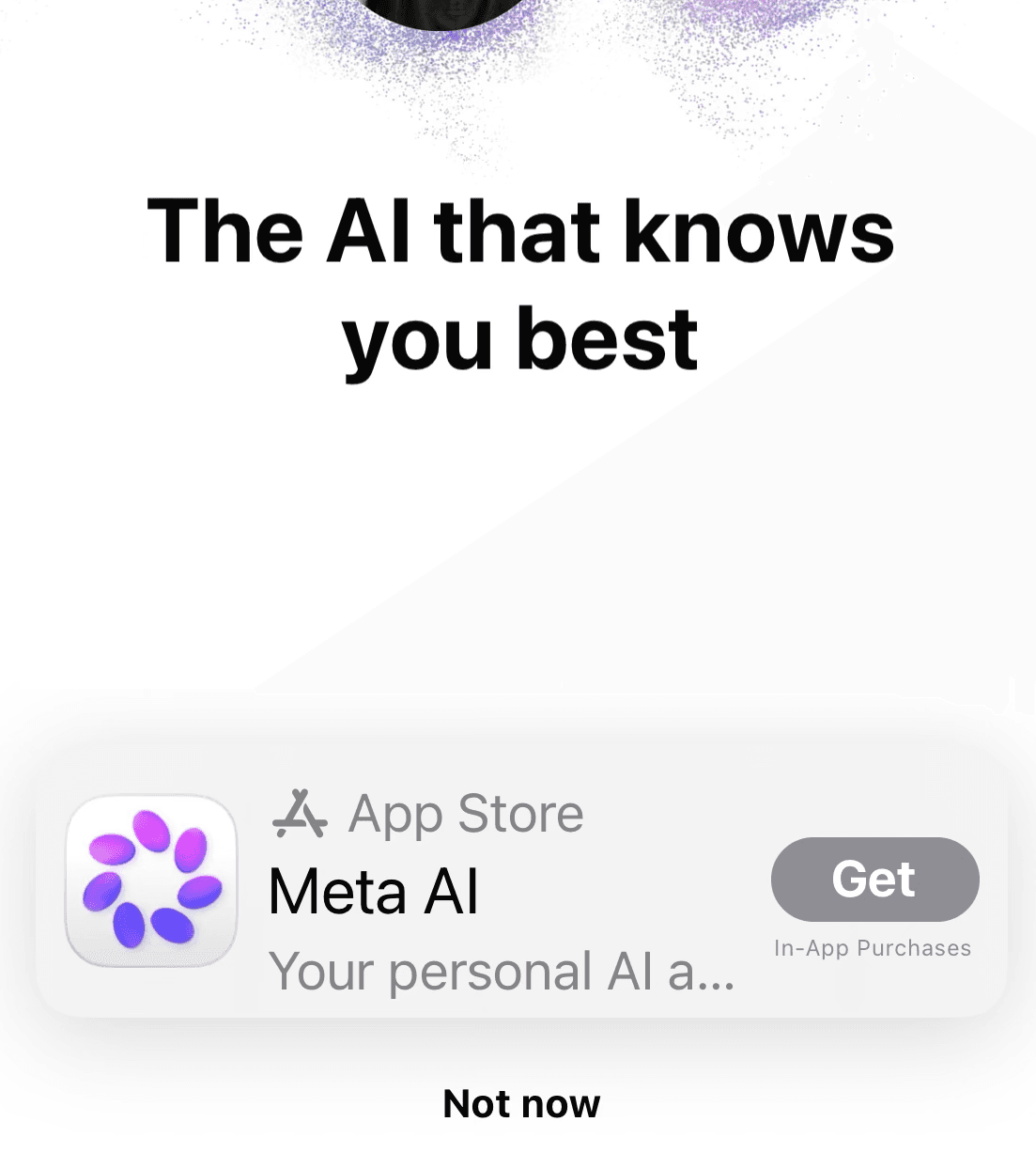
And it certainly does not knock on my door in the morning with a smiley face and a big OKAY button to announce that it is the AI that knows me best. Nobody is going to be tricked into this. They are going to be greeted into it, which is worse. When Meta's AI did surface what it had been holding, WIRED found a Discover feed full of strangers' bizarrely personal chats, served up as a feature. The OKAY button is built beautifully and it is on every screen. The blush, the door that closes, the file I get to edit — none of that ships by default to a billion phones.
So, for the record: I have never found a button anywhere that I can click to make Meta forget what it knows about me. I am still looking. My Chinese AI bot is still looking. There are tidy guides on how to mute the thing, and a mute is not an erase. The OKAY is everywhere; the forget button I have never once seen. If anyone finds it, let us know — and until then, my AI will keep going to bed when I do, and theirs will keep watching you while you sleep.
Until then: fuck you, Meta.