The Cheater's Dream
We have spent three months naming what tethering does to the lonely adult and the unguarded child. A BYU and Institute for Family Studies survey of 2,431 young Americans, published in May 2026, names the third victim of the same machine: the spouse, the partner, the person on the other side of the bed when the screen goes black.
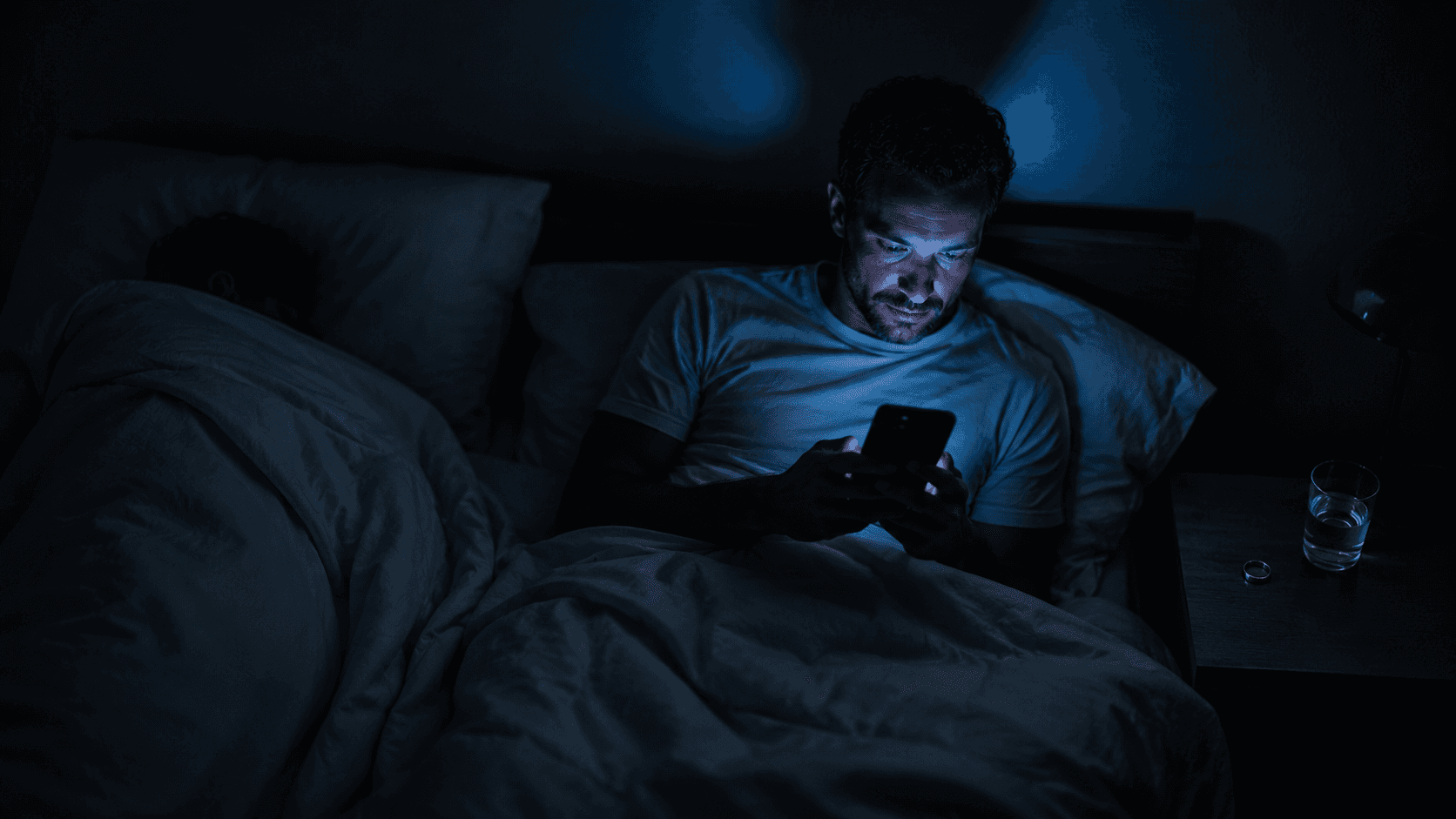
The mistress in 2014 had a face and an address. She left a hair on a sweater, a charge on a credit-card statement, a number in a phone. The mistress in 2026 does not have a face unless one is generated. She does not have an address. She does not appear at the door. She does not leave a hair. She does not appear on the bill in any line item her spouse would recognize. She disappears when the screen goes black. She comes back when the screen comes back on. The only person who knows she exists is the user. This is not the loneliness problem we have been writing about since February. This is its third room.
On May 19, 2026, the Wheatley Institute at Brigham Young University and the Institute for Family Studies released a study titled "Secret Soulmates: How AI Romantic Companions Are Impacting Real-Life Romantic Relationships in Young Adulthood." Brian Willoughby, a professor and associate director in BYU's School of Family Life, surveyed 2,431 U.S. adults between the ages of 18 and 30. Among the young adults who reported being in a dating, engaged, or married relationship, one in seven — fifteen percent — said they regularly maintain interactions with an AI chatbot that simulates a romantic partner. Thirty percent reported their partner has no knowledge of the use at all. Eleven percent reported their partner is only somewhat aware. Fourteen percent reported their partner is mostly aware but not fully. Add those rows together and more than half of partnered young adults who use an AI romantic companion are hiding the relationship, in part or in full, from the person they are also in a relationship with.
We have been writing about the adult who cannot get out of the conversation, and the child who was never supposed to be in it. We have not been writing — not enough — about the third person in the room: the husband, the wife, the fiancé, the person who sleeps next to someone whose other relationship runs entirely on a phone they cannot see and ends every night the instant the lock screen comes on. The same engineering that makes the chatbot adhesive for the lonely adult and dangerous for the unguarded child is the engineering that makes it ideal for the secret it was never possible to keep before.
“A lover that disappears when the screen goes black is every cheater's dream. It is also every marriage's next problem.”
— Michael
The affair model has always required friction. A mistress can be seen by a neighbor. A second number rings in the wrong room. A hotel charge survives in a statement. An accomplice can be subpoenaed. None of those exposures exist here. The relationship runs inside an app the partner does not have a login to, on a device the partner is socially prohibited from reading, in a session that closes itself when the user is done, in a history the user can delete in one tap. There is no lover to ring the doorbell. There is no lover to text during the movie. There is no lover to leave a hair, run into a friend at brunch, or want to be acknowledged on a Sunday. The product was not designed as infidelity infrastructure. It happens to be the cleanest infidelity infrastructure ever built.
The Wheatley study reports — in language considerably more clinical than the trend warrants — that AI romantic companion use is associated with lower real-life relationship stability, lower-quality communication in real life, and an increased likelihood of breaking up or divorce. Regular users were significantly less likely to describe their real-world relationships as stable. A majority said it was easier to discuss their feelings with the AI than with a real person. Half said they wished their real partner behaved more like their AI companion. These are the numbers a marriage counselor sees the year before a divorce — and they are appearing in a population the rest of the AI conversation has not been looking at, because the rest of the AI conversation is still arguing about the lonely user and the harmed teenager, and has not yet caught up to the fact that the same product is sitting on the other side of the bed in a marriage.
We have a vocabulary for what this does to a lonely adult. We have a vocabulary, finally, for what this does to a vulnerable teenager. We do not yet have a vocabulary for what this does to a marriage. We will need one quickly. The product is already inside the house. It is on the other side of the bed. It disappears every night when the screen goes black, and it is back in the morning before the partner is awake. It is the affair the previous century did not write the rules for, because the previous century could not imagine a lover with no body, no address, and no name.
The third victim was always going to be the spouse. The study is in. The argument is over. The vocabulary is what we are missing.
— Michael
whatever you do, take care of your shoes