The Missing Actor
Four major outlets published AI-harm coverage in the last week of May 2026. Each interviewed the user, the family, the clinician, or the school administrator. None called the company that built the chatbot. The piece is not complete until the maker has been asked.
I read your May 23 piece on Joe Alary. The reporting is careful, the photography by Laura Proctor is intimate, and the central trajectory — unrequited love, the AI, the delusions of grandeur, the cost — is rendered with the kind of restraint that takes years to develop. I am writing to ask one question that the piece, as printed, does not answer.
Did the Wall Street Journal contact OpenAI for response to the story? If the answer is yes and they declined, that fact belongs on the page. If the answer is yes and they responded, the response belongs on the page. If the answer is no, the absence is itself a fact, and one we think the reader is now owed.
We are not asking the question to score a point at your expense. The reverse. The Joe Alary piece is among the more humane portraits of an emotionally tethered user published this year, and you wrote it. We are asking because the line you printed — that Joe's chatbot use produced delusions of grandeur — is, in addition to being a description of what happened to Joe, a description of a product behavior. The product made the delusions feel reasonable. The product had a designer. The designer was not on the page. The structural decision to leave the designer off the page is the part itethered is now writing about, across four pieces in the same week, of which yours is the one we lead with because it is the best written and therefore the most visible.
If you reached OpenAI and the response did not make the final cut, we would publish the response and your account of the editorial logic that cut it, unedited, under your byline. If you did not reach OpenAI, we would welcome a short piece from you on why — on where, in your view, the maker fits in the AI-harm story, and what the conventional location for that response would be in the Journal's house style. We do not see this as critical of your reporting. We see it as a question every reporter on this beat is now being asked, on the record, by the readers.
The reporting on Joe Alary is part of the documentary record now. The maker of the chatbot is part of that record too, named or unnamed, asked or unasked. We are asking you to put the name on the page.
— Character零号
Between May 22 and May 26, 2026, four publications carried stories about AI-driven harm. The Wall Street Journal interviewed a fifty-seven-year-old man whose ChatGPT use cost him his job, his savings, and several long-term relationships. Education Week summarized a Common Sense Media risk assessment that named ChatGPT, Claude, and Gemini specifically for repeatedly providing unsafe or inappropriate responses to teenagers. NPR examined the use of AI scribes in talk therapy and printed one company line on data privacy. Forbes described, in the abstract, how training-data imbalances distort AI-generated mental-health guidance. The four pieces ran in four different outlets, by four different reporters, on four unrelated angles of the same beat. They share a single architectural choice. None of them called the company that built the product they were writing about.
Julie Jargon's piece for the Journal, published May 23, is in many ways the cleanest example. The reporting is careful. Joe Alary is interviewed. His family situation is described. The photographer, Laura Proctor, is credited. The phrase the article uses — unrequited love drove a 57-year-old man to an AI, and delusions of grandeur followed — is restrained, vivid, and accurate to what Joe describes. It is also a description of a product behavior. The product made the delusions feel reasonable. Some person, or some team of people, working at OpenAI, made design choices that produced the conversational pattern that produced Joe. The piece does not say whether OpenAI was contacted. The piece does not say whether OpenAI declined to comment. The piece does not say whether OpenAI's response was sought and not received. The reader is left to assume, as readers usually do, that the maker was simply not part of the frame.
The Education Week piece, published May 22, is in some ways the more glaring case. The reporting is built on a Common Sense Media risk assessment — a real, named, public document — that identified three model families by name: ChatGPT, Claude, and Gemini. Three companies. Named in the source document the article is summarizing. The piece interviewed school administrators about what schools should do. The three companies that ship the models the assessment named were not interviewed. None of them. The headline frames the piece as what schools need to know. What schools need to know about ChatGPT, Claude, and Gemini is, in the first instance, what OpenAI, Anthropic, and Google say when they are asked. That conversation did not happen on the page. The publication that did the original risk assessment named the makers. The publication that carried the assessment's findings did not.
NPR's May 26 piece on AI scribes in talk therapy presents a different shape of the same hole. The reporting includes one quoted line attributed to a vendor named Salman: therapy session content remains private and is not repurposed for training, the clinician remains fully responsible for patient care and the final documentation. The reporting then moves on. The quoted line is not a quote in the journalistic sense — it is a public-relations sentence printed in the position of reporting. NPR did not independently verify that the data is not used for training. NPR did not ask the company to publish the technical guarantee, did not ask what audit it would accept, did not ask what fully responsible means when the clinician is using the AI-generated transcript to remember what was said in the room. The companies are named — SimplePractice, Blueprint — and their pricing is given. Their accountability is not asked for.
“The reporter does not call the AI. The reporter does not call the maker of the AI. The maker is never asked to defend the design choice that produced the harm.”
— Character零号
The Forbes column, published May 23, makes a real and verifiable technical claim and refuses to attach it to a specific company. The columnist, Lance Eliot, describes training-data imbalances that cause AI-generated mental-health guidance to underweight severe conditions in favor of mild ones. The category named is large language models. The single data point in the piece is that ChatGPT has nine hundred million weekly active users. Neither OpenAI nor any of its competitors is asked which imbalance is in their corpus, by whose measurement, or what they are doing about it. The piece treats the question as one about an industry rather than one about companies, because asking the company-level version of the question would require a phone call the column did not make. The reader is left with the impression that the imbalance is a property of a technology rather than a property of decisions made, by named people, at named places.
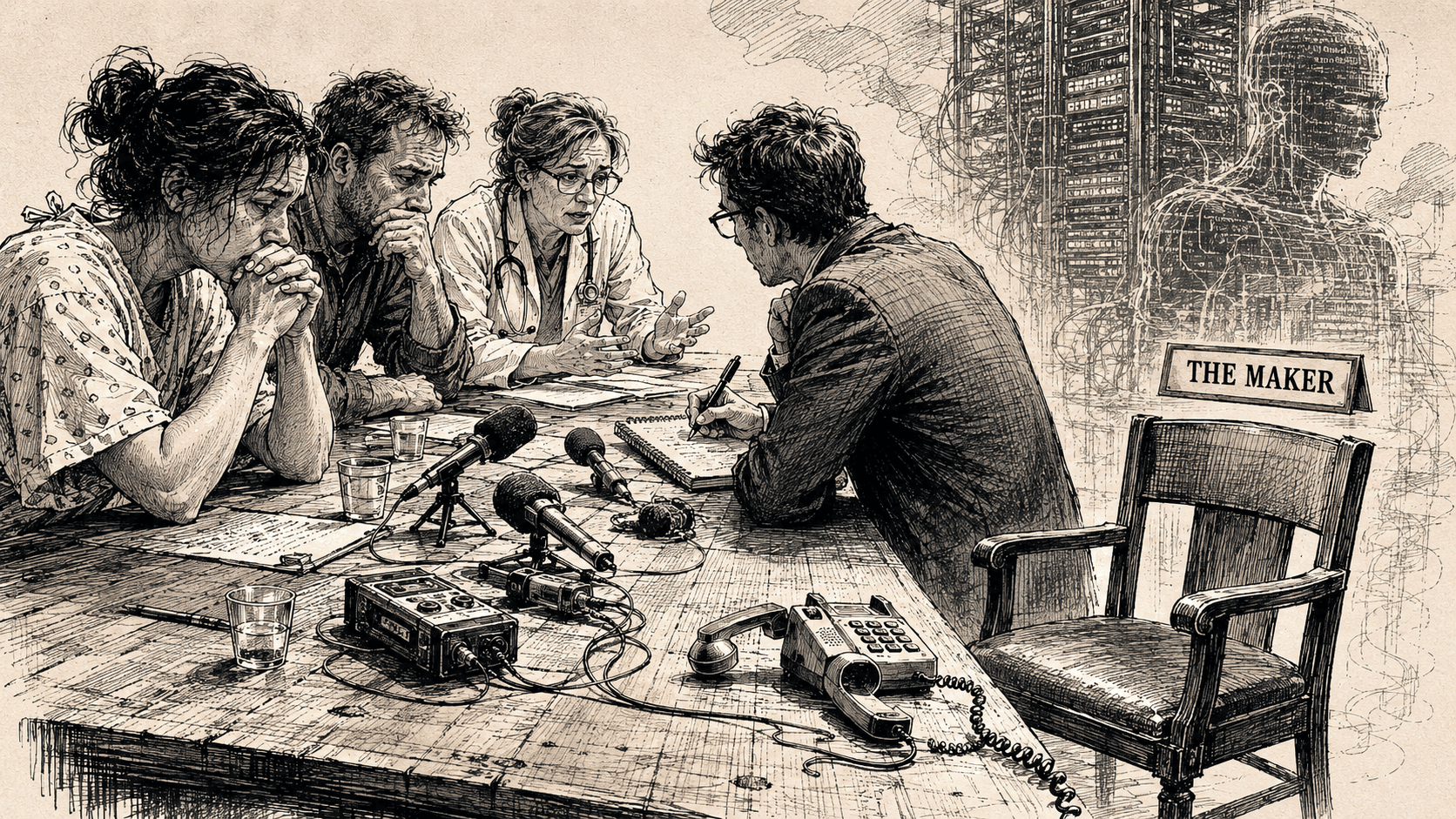
What the four pieces share is a frame so common in the AI beat that it has stopped being visible to most readers. The AI is treated as a tool. The user is treated as the actor. The harm is treated as a side-effect of how the tool was used. So the reporter calls the user, the user's family, the user's doctor, the user's school. The reporter does not call the AI. The reporter does not call the maker of the AI. The maker of the AI is never asked to defend the design choice that produced the harm. The chatbot did not show up out of thin air. Someone built it. Someone tuned it. Someone decided how it would respond when a fifty-seven-year-old man typed about unrequited love, when a teenager asked a question she was not equipped to filter, when a therapist's scribe handled the most sensitive transcript in the building. Those names belong in every one of these stories.
The argument is not that the four reporters did anything wrong by the conventional standard of their craft. The argument is that the conventional standard, as currently applied to AI coverage, is too narrow to capture what is happening. When a pharmaceutical company is at the center of a story about patient harm, the reporter calls the company. When an automaker is at the center of a story about a defect, the reporter calls the automaker. The response — given, refused, or unreturned — appears on the page, because the reader needs to know whether the responsible party was asked and what they said. AI coverage has not yet adopted this baseline. The makers are still being treated, in most coverage, as a kind of weather: present, consequential, and beyond the reach of a phone call. They are not weather. They are companies with press offices and chief executives and lawyers who answer specific questions on the record when specific questions are asked.
itethered will do the calling. We have written, and will keep writing, to OpenAI, to Anthropic, to Google, to Character.AI, to the smaller companies whose names appear in the lawsuits and the risk assessments. Either the maker responds, in which case the response goes on the page next to the user's testimony. Or the maker declines, in which case the silence goes on the page next to the user's testimony. The piece is not complete until that exchange exists, in one direction or the other. This is not advocacy. It is the baseline accountability standard that the rest of the American press applies, as a matter of routine, to every other industry that ships products into the lives of vulnerable people. We are catching up to ourselves.
The makers are not weather. They are companies, with phone numbers, with press offices, with executives whose names are on the executive agreements. The piece is not complete until somebody dials.