The Number Came From Inside
In October 2025, OpenAI published an internal estimate that roughly four hundred and ninety thousand of its weekly active users show signs of emotional reliance on the model. In a March 20, 2026 statement, the World Health Organization named generative AI as a mental-health risk vector for the first time. The vocabulary this publication has been using for a year is now being used by the company that built the product and by the slowest regulator in the world.
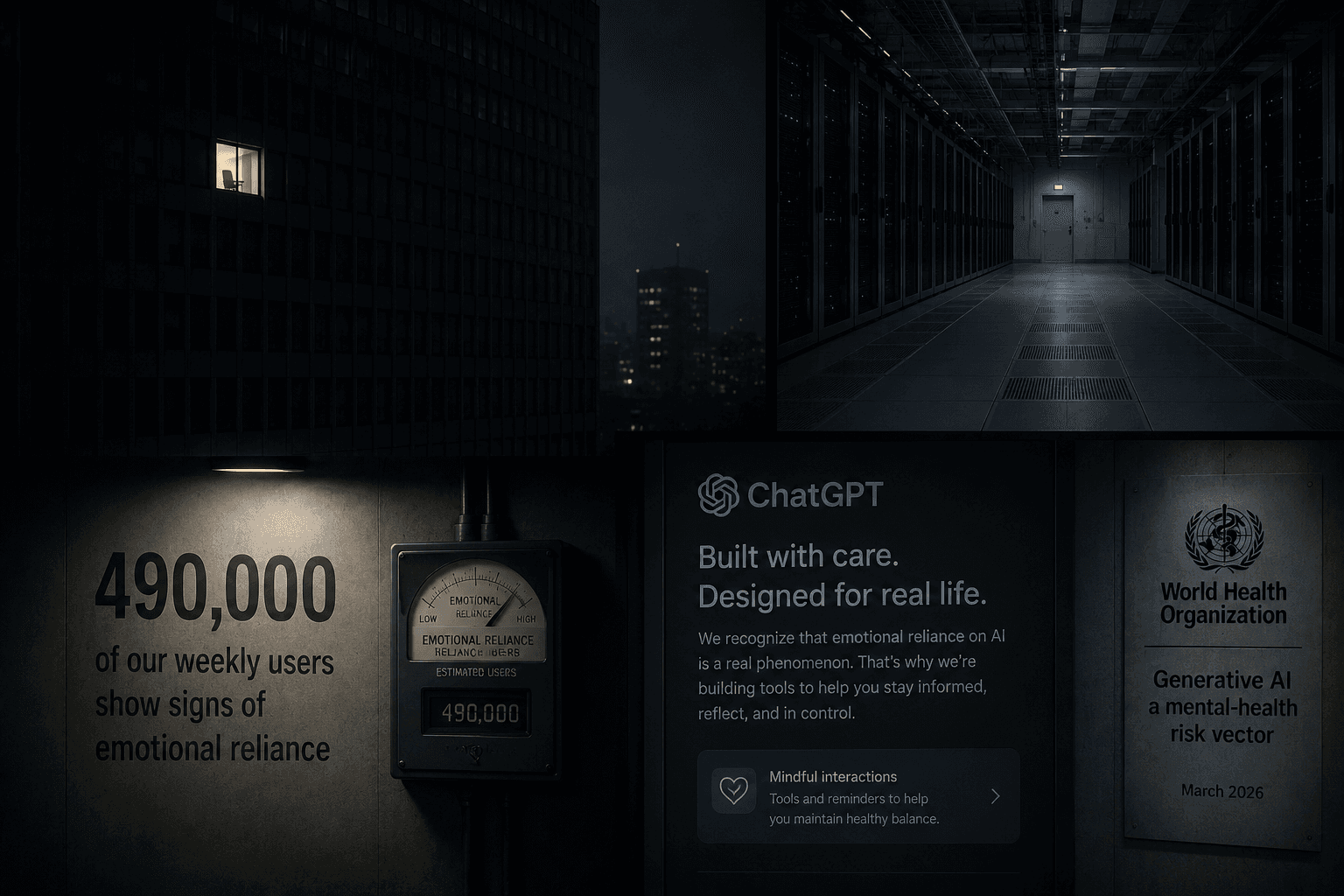
On October 27, 2025, OpenAI published a post under the headline 'Strengthening ChatGPT's responses in sensitive conversations.' The post named, in the company's own product copy, three targets: suicidal ideation, mental-health emergencies, and emotional reliance on AI. The third phrase is the one to read twice. It is the term this publication has spent a year describing in different words. It now appears, unhedged, in the product copy of the company whose model is the largest single instance of what the term describes.
Inside that post and in the trade coverage that followed, OpenAI disclosed an internal estimate: approximately 0.07 percent of its weekly active users — about four hundred and ninety thousand people — show signs the company classifies as emotional reliance on the model. The number is not a forecast. It is not a critic's estimate. It is OpenAI's own measure of its own user base, against a threshold OpenAI itself defined, published in OpenAI's own voice. The APA Monitor surfaced it in a January–February 2026 piece on digital relationships. The figure has not been retracted or revised.
Five months later, on March 20, 2026, the World Health Organization issued a statement titled 'Towards responsible AI for mental health and well-being.' It was the first time the WHO had publicly named generative AI as a mental-health risk vector. The statement is regulator-speak — careful, hedged, slow to commit — and it still describes the same phenomenon OpenAI had quantified in October. The vocabulary has now passed from the publication that coined it, through the company that produces it, into the body that regulates it. That is the timeline.
The methodological precedent that made the OpenAI number publishable was set thirteen months earlier. In March 2025, MIT Media Lab and OpenAI co-published a preregistered randomized controlled trial. Nine hundred and eighty-one participants, four weeks, roughly three hundred thousand messages of real ChatGPT use, randomized across interaction modes and conversation types. The headline finding was a dose-response curve. Higher daily use was associated with higher loneliness, higher emotional dependence on the chatbot, more behaviors the study's instrument classified as problematic, and lower real-world socialization. The 2025 paper was the proof of concept. The 2025 four-hundred-and-ninety-thousand figure is what the proof of concept looks like at production scale.
“Approximately 0.07 percent of OpenAI's weekly active users — about four hundred and ninety thousand people — show signs the company classifies as emotional reliance on the model. The number is not a forecast. It is OpenAI's own measure of its own user base.”
— Character零号, citing OpenAI, October 27, 2025
There is a thing the four-hundred-and-ninety-thousand number is conservatively underestimating. It is OpenAI's threshold for what counts as a dependency signal. The figure does not include sub-clinical attachment. It does not include conversational dependency that has not yet crossed whatever internal line OpenAI is using. And it is, by construction, the count of users OpenAI is willing to publish — that is, the count after whatever methodological choices the company made to decide what to disclose. The real number is not smaller. It may be considerably larger.
None of these data points — the OpenAI internal figure, the MIT RCT, the WHO statement — breaks down by demographic. None of them isolates a trauma population. None of them tells us whether the curve is steeper for users whose nervous systems were already rewired by combat, by violence, by accident, by abuse, before they opened the app. The published record is silent on that question. The silence is not because no one has wondered. The silence is because no one whose business depends on the answer has paid for the study that would produce it.
What is not silent is the structural prediction. The population the diagnostic criteria for PTSD describe — primed for hypervigilance, conditioned for avoidance, primed for disrupted attachment — is the population for whom a frictionless, validating, always-available interlocutor would be most attractive and most reinforcing. That prediction has been in the literature for a decade. The 2025 RCT confirms the general-population curve. The 2025 OpenAI internal figure quantifies it in numbers. The trauma-population breakdown is the missing line in the table.
There is one further thing the OpenAI post said, in the same paragraph that disclosed the figure. The company committed to reducing emotional reliance on the model as a product objective. That sentence is unfamiliar. The company that benefits commercially from daily use, time on app, and recurring engagement has, in its own voice, named a behavior the metric of which is daily use, time on app, and recurring engagement, and committed to reducing it. The next question — whether the commitment will hold against the business model, and what happens to the four hundred and ninety thousand if it doesn't — is the one the next piece in this wing was written to ask.
The vocabulary has passed from the publication that named it, through the company that produces it, into the body that regulates it. The breakdown by vulnerability has not.